
The Biggest Risk in Batch Subtitle Extraction Isn’t Speed—It’s File Chaos
For multi-episode content, extraction accuracy is only the baseline. Every subtitle file must map clearly to its source video.
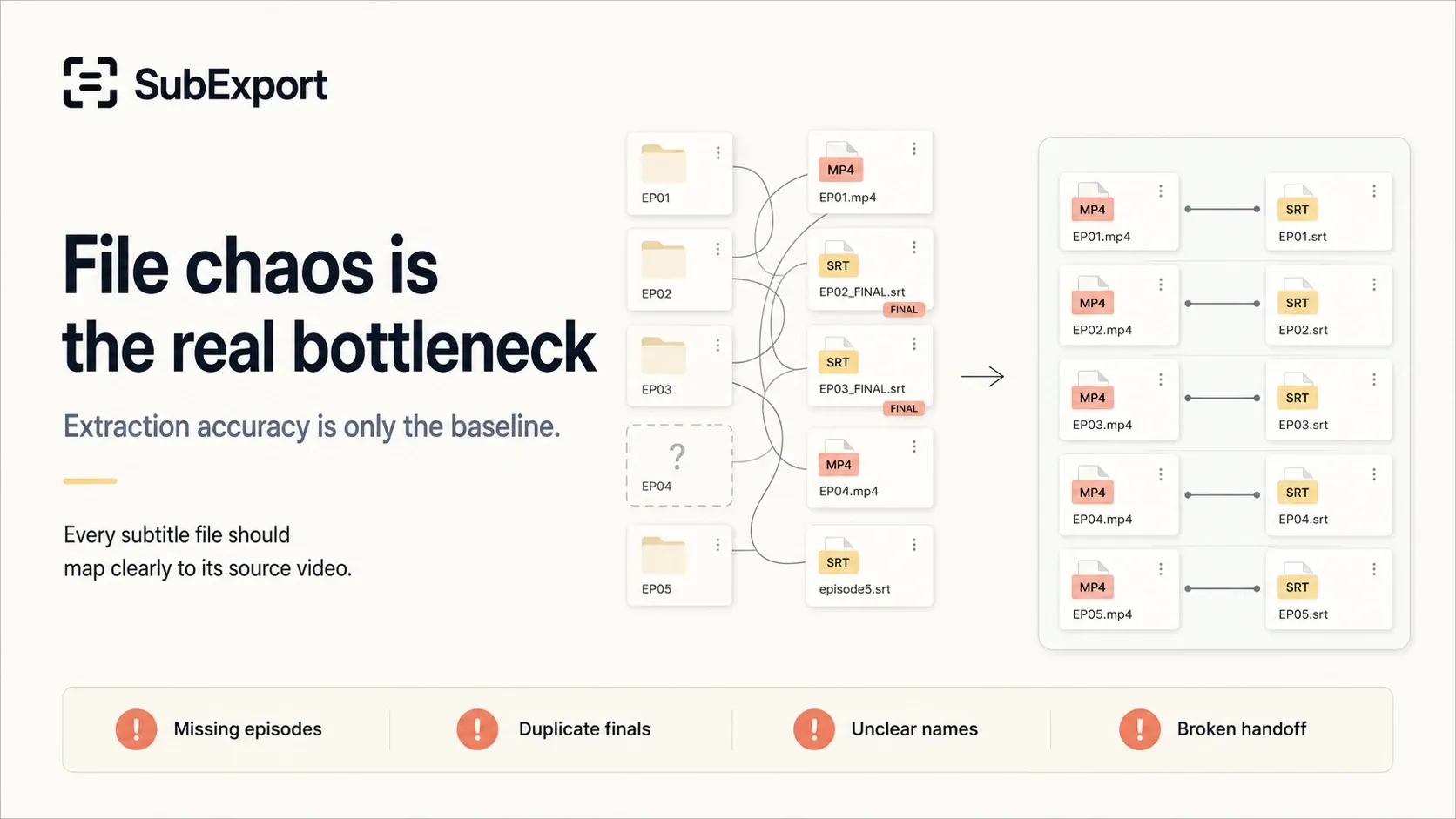
A 30-episode drama can produce a folder full of subtitle files and still be nowhere near ready for localization. One file uses the episode number. Another keeps a camera filename. Two versions both say “final.” One episode is missing, but no one notices until the editor starts importing captions.
At scale, subtitle extraction becomes a file-control problem as well as a text-recovery problem.
Volume turns informal naming into production risk
With one clip, a team can recognize the source from memory. With dozens of episodes, every source video may generate a subtitle file, a translated file, an edited version, and one or more rendered outputs. An unclear relationship at the first handoff multiplies across the rest of the workflow.
If several people handle extraction, individual naming habits make the problem worse. The project lead must then identify duplicates, locate missing episodes, rename files, and rebuild a source-to-subtitle map before translation can begin.
A batch is not organized merely because all the files are in one folder.
Poor mapping forces every downstream team to verify again
Translators need to know which source-language subtitle belongs to which episode. Editors need to import the correct SRT into the correct video. Operations teams need to know whether the batch is complete.
When the mapping is unclear, each team reopens files and repeats the same identification work. The extraction may have been fast, but the project remains slow because certainty was not delivered with the text.
For a series, avoiding repeated verification is often more valuable than saving a few minutes during recognition.
Define the delivery structure before extraction begins
A usable multi-episode subtitle package should establish:
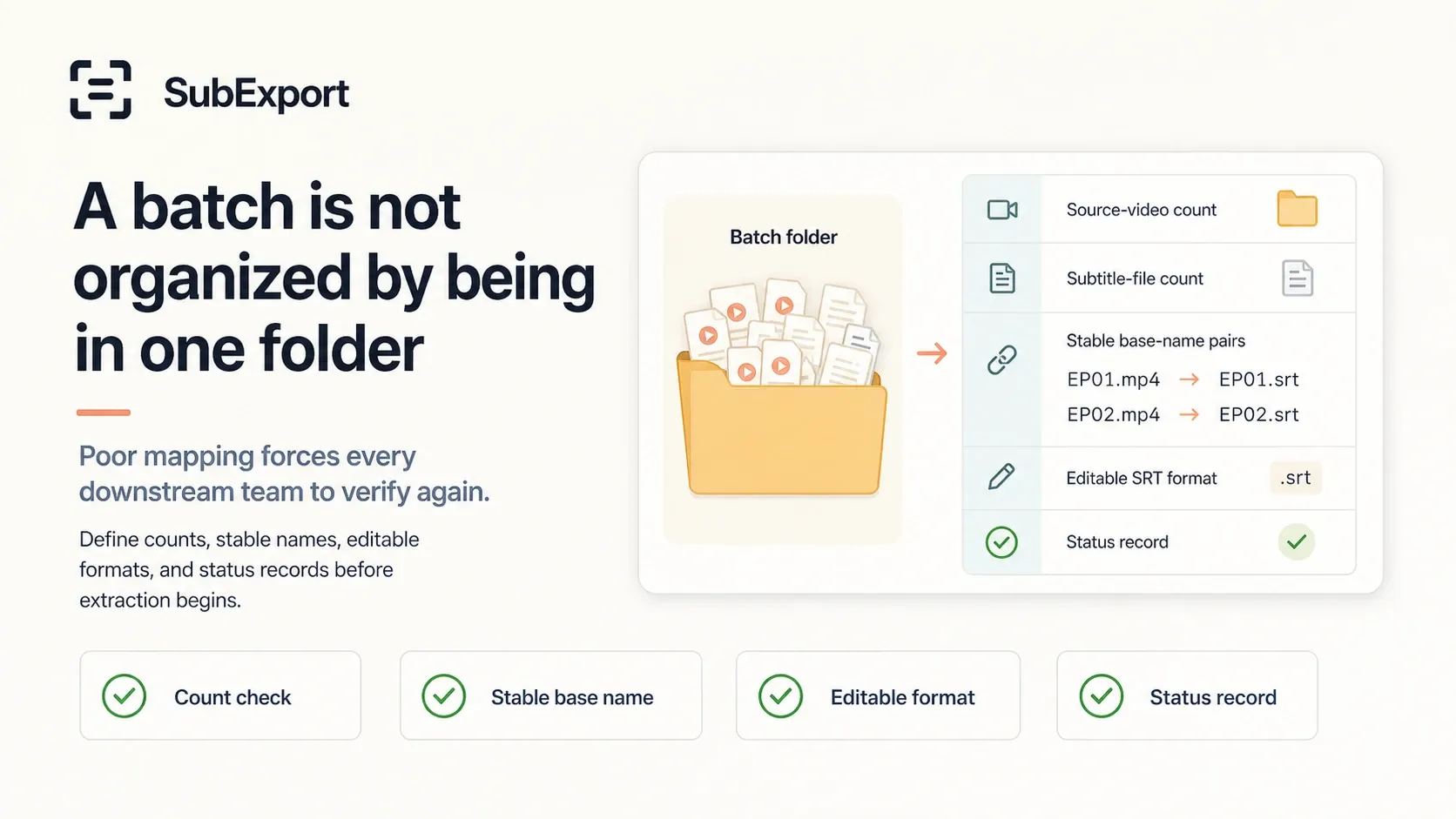
• the expected source-video count and subtitle-file count
• one stable base name connecting each video to its subtitle file
• a clear rule for alternate source versions
• the required editable subtitle format
• a status record for failures, unreadable files, or items awaiting a decision
These rules make completeness verifiable. They also let the next team begin work without first reconstructing the project.
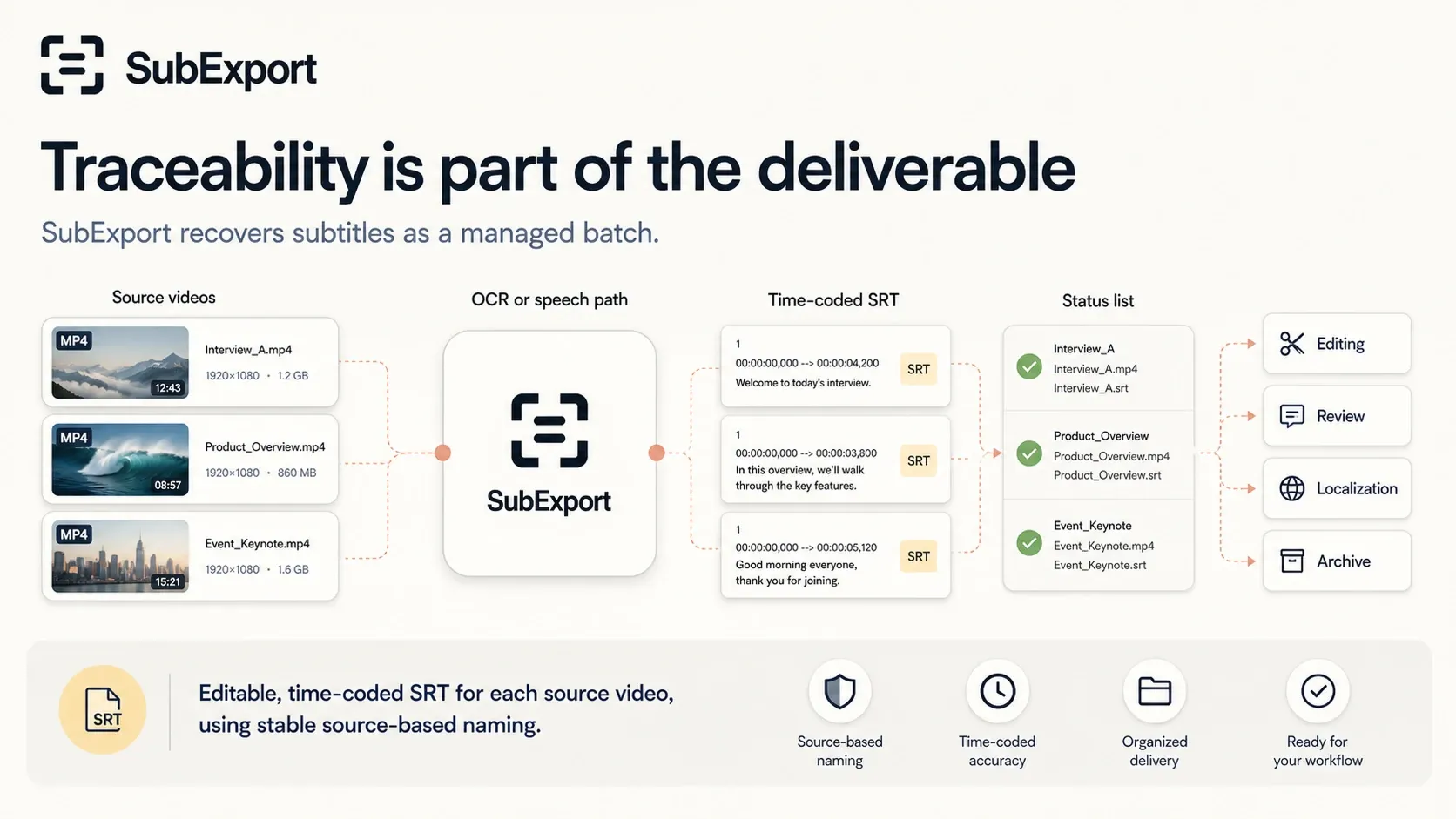
SubExport recovers subtitles as a managed batch
SubExport is a managed service for batch video subtitle extraction and organization. When visible subtitles are burned into the picture, the service can use hard-subtitle OCR to recover text and timing. If there is no usable hard subtitle and speech is intelligible, speech-to-subtitle extraction can be evaluated as the alternative path.
The standard delivery is an editable, time-coded SRT for each source video, using stable source-based naming, together with a status list for failed or unresolved items. Translation, hard-subtitle removal, dubbing, and full video localization are separate services rather than hidden inside the extraction scope.
The result is a subtitle asset package that can move into editing, review, localization, search, or archive work.
Measure completion by whether the next team can start
The fastest extraction process has little value if translators and editors spend another day matching files. For multi-episode content, traceability is part of the deliverable.
If you have a series or video library that needs editable subtitles, provide the file count and duration, source naming structure, visible-subtitle or audio conditions, required format, review requirements, and intended next use. SubExport can confirm the extraction path and batch delivery scope.
Learn more about SubExport
Visit the website: Learn about SubExport
Submit your subtitle extraction project: Contact us